What bearers and joists are, and why they go
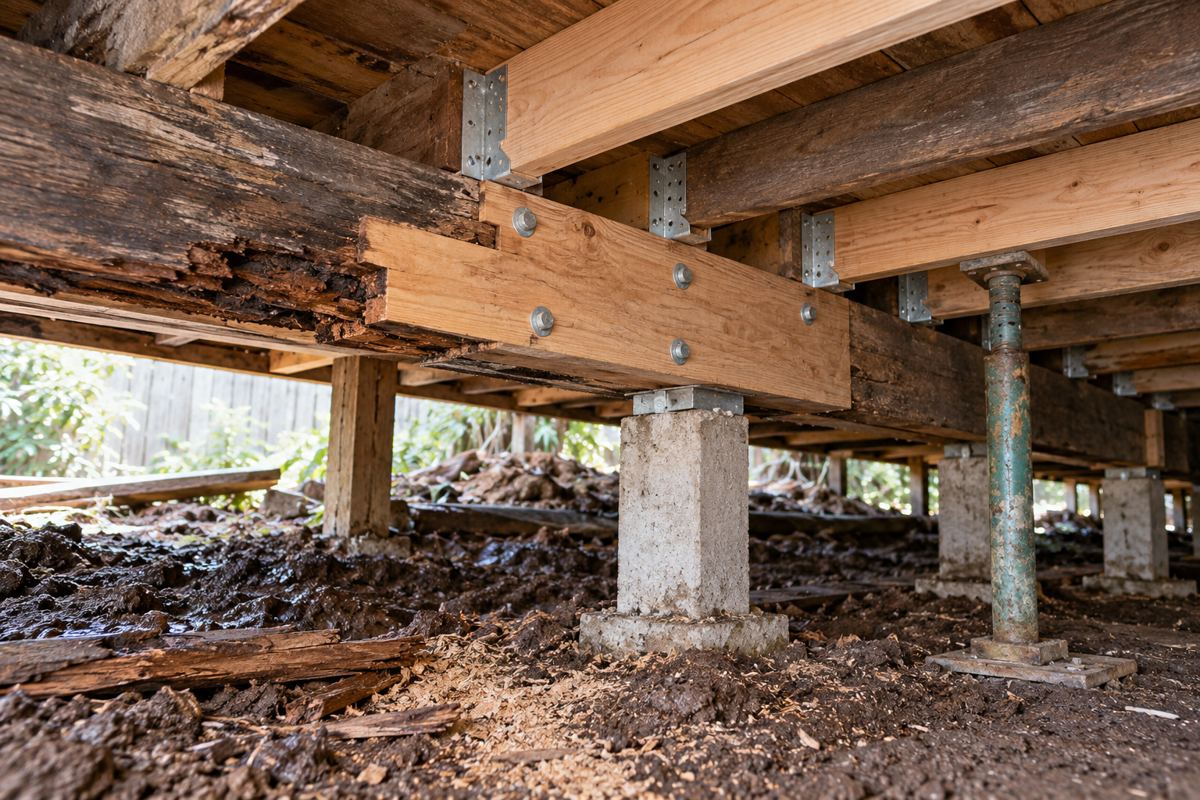
Bearers are the heavy timbers that run along the tops of the stumps. Joists run across the bearers, closer together, and the floorboards or sheet flooring are fixed to the joists. In a Peninsula house built before the 1970s the lot is usually hardwood, and all of it has spent decades a few hundred millimetres above sand or clay with little air moving past it. Bearers rot where they sit on a stump that is holding water, where a leaking shower or a disconnected downpipe has kept one corner wet, and where the end of the bearer is let into a brick pier or buried under a verandah. Joists rot under bathrooms and laundries, at their ends on an outside bearer, and wherever the floor above has been wet for years. Termites, which the whole Shire is designated subject to under regulation 150 of the Building Regulations 2018, take the rest.
A rotted bearer is why a floor can be bouncy or dipped between two stumps that are themselves fine. It is also why a quote that only counts stumps is only half a quote.
When it is found
Almost always during restumping. The base boards are off, the house is on jacks, the crew is under the floor with a torch, and the bearer that looked sound from the side is soft when it is probed. That is the cheapest moment to replace it and the worst moment to argue about price, which is why a restumping quote should say in advance how bearer and joist work is charged: per metre of bearer, per joist, and whether lifting the floor is included. The restumping page covers the sequence.
It is also found by building inspectors before a sale, by pest inspectors following termite galleries up from the stumps, and by renovators lifting a bathroom floor in a Rye holiday house to find there is not much holding it up. On the Peninsula there is a fourth route: the owner arrives for the first weekend of spring, the bathroom floor gives underfoot, and a shower that has been leaking since Easter has had a whole wet season to work on the joists with nobody there to notice.
Whoever finds it, the same rules apply to fixing it. The work is done by a builder registered with the Building and Plumbing Commission, because the same crew and the same jacks are under the house as for restumping, and registration for restumping applies regardless of the value of the work. Over $10,000 the whole job needs a written major domestic building contract under the Domestic Building Contracts Act 1995, and from 1 July 2026 the builder must hold Home Warranty insurance where the work costs more than $20,000. Bearer and joist work is what most often pushes a small partial restump across one of those lines part way through, which is another reason the rate for it belongs in the contract from the start rather than on a variation at the end.
| What you notice | What it usually is | What is done |
|---|---|---|
| Floor dips between two stumps, both stumps sound | Bearer sagged or rotted at a stump | Bearer cut back to sound timber and replaced over the stump. |
| Floor bounces in one room, stumps fine | Joists undersized, cut for old plumbing, or rotted at the ends | Joists sistered or replaced in hangers. |
| Soft spot by the shower or the laundry trough | Joists and sheet flooring rotted from above, bearer below starting | Floor up, joists out, bearer checked, plumbing fixed first. |
| Mud tubes on a stump, frass on the ground | Termites in the bearer above | Damaged timber out, pest controller in, caps and inspection schedule. |
| Verandah floor low at the front step | Short verandah bearer on short stumps close to wet ground | Bearer replaced, stumps checked, ground graded away. |
| Tide mark along a bearer at the same height on one side | That side of the house stands in water each winter | Drainage first, then the timber, or the new timber goes the way of the old. |
How the repair runs
- Find the extent. Rot is probed along the bearer until sound timber is reached. Half a metre of soft timber at a stump often means a metre and a half comes out.
- Support the floor. Jacks and props carry the joists either side of the section being replaced, so the floor above does not drop while the bearer is out.
- Cut out and replace. The rotten length is cut back to sound timber over a stump, and a new hardwood bearer of the same section is fitted, scarfed and bolted to the old with galvanised bolts and a splice plate, sitting on the ant cap of the stump below.
- Joists. Rotted joists are cut out and new hardwood joists fitted in galvanised hangers, or sistered alongside the old where the old is sound enough to help. Under wet areas the floor comes up to do it, and the plumber fixes the leak before the new timber goes in.
- Treat and ventilate. Where termites were the cause, a licensed pest controller treats the house and sets up an inspection schedule. Where damp was the cause, vents are added and the ground regraded; otherwise the new timber is on the same clock as the old.
- Permit. Replacing a bearer or joist that holds up the floor is altering an element that supports other elements, which the Commission's practice note BP-01 excludes from the repair exemption. It is normally covered by the restumping building permit when done together; done on its own the registered building surveyor decides, and the work is still done by a BPC registered builder.
What the Peninsula adds
Wet-area corners on the Western Port side. The bathroom and laundry corner of a Hastings, Tyabb or Somerville weatherboard is almost always the worst. The Hastings unit holds surface water in wet periods and the Bittern unit waterlogs, so a shower that has leaked for a decade into a subfloor that never dries takes the joists, then the bearer, then the stump, in that order, and the repair goes in the other order. The Cerberus record says June averages 73.5 mm and the subfloor on that side does not see dry ground until summer.
Verandah and sleep-out bearers on the holiday houses. The post-war holiday houses and weatherboards from Dromana round to Sorrento often grew a sleep-out, a laundry or a front verandah on their own short stumps and low bearers, close to the sand, under a deck or a concrete apron that traps water. Those bearers are the first to go and the easiest to miss, because they are not under the main house where the inspector looks.
Salt and fixings. Near the beach the bolts, straps and joist hangers are hot-dip galvanised or better, because a steel hanger that rusts through in salt air lets a sound joist drop. It is a small line in the quote and worth checking.
Hardwood that is still good. The original hardwood in a 1920s cottage in Portsea or a 1950s weatherboard in Mornington, where it has stayed dry, is as sound as the day it went in. Replacement is done to sound timber, not wholesale, which costs less and keeps the floor the house was built with. In the heritage precincts at Sorrento and Portsea none of this work is visible from outside, which is arguably maintenance under the Heritage Overlay; if the base cladding has to change to get at the bearers, ask the Shire's heritage team first.
The termite rule. With the whole Shire designated termite prone, the Shire's page points to AS 3660.1 for new houses and extensions, and the NCC 2022 Housing Provisions Part 3.4 sets out termite risk management for new work. A bearer replacement is a repair rather than new work, but the same logic applies: caps on the stumps, clearance under the floor, and a pest inspection schedule that an absent owner actually keeps.
Managing it from Melbourne
Bearer and joist work is the part of a restump most likely to change the price after the owner has gone back to the city, because it is only found once the base boards are off. The practical answer is a quote that sets the rate per metre of bearer and per joist in advance, a builder who photographs each soft section before cutting it and sends the photograph with the length, and an agreed limit above which the builder rings before going further. That turns a surprise into a sum. For a house being sold, ask for the before and after photographs to go with the final certificate, because the next building inspector will want to see what was replaced and where.
What bearer and joist repairs cannot fix
They cannot dry out a subfloor. New hardwood over wet clay or damp sand rots as the old did, so drainage and vents go with the repair or the repair is temporary. They cannot level a floor on stumps that have failed; the stumps come first. They cannot be done from above alone where the bearer is the problem: the base boards have to come off and the house has to be supported. They cannot fix the shower or the downpipe that caused the rot, which is a plumber. And they cannot stop termites coming back to a house with no caps, no clearance and no inspection schedule.
Check the current rules before you rely on this
This page describes bearer and joist replacement under homes on the Mornington Peninsula, usually carried out with restumping. It describes the rules in general terms as they stood in October 2026. Standards, forms, thresholds and fines change.
The authoritative sources are Building and Plumbing Commission practice note BP-01, when is a building permit required, Building and Plumbing Commission (as the VBA) on registration being required for restumping and reblocking at any value, Mornington Peninsula Shire, termite management and maintenance, National Construction Code 2022 Housing Provisions, Part 3.4 termite risk management and Bureau of Meteorology climate statistics, Cerberus. Where anything here differs from those sources, they are right and we are not.
We are not building surveyors, engineers, planners or lawyers. For what applies to your house, ask a registered building surveyor or ring Mornington Peninsula Shire on 1300 850 600.
Accurate at the time of writing, October 2026. Always check the source before relying on it.